
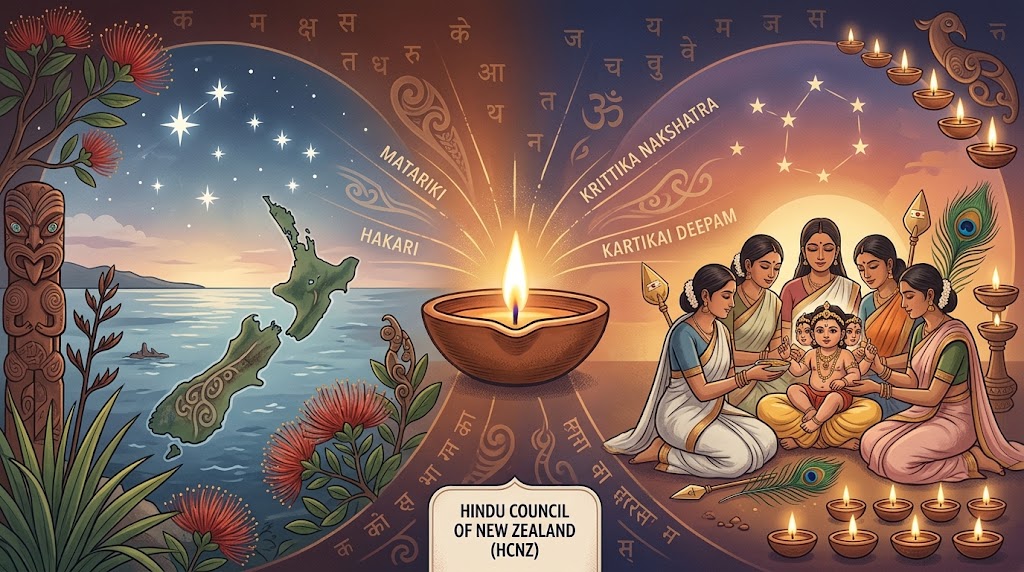
Across human civilisations, celestial cycles have long guided agriculture, community gatherings, and spiritual reflection. In Aotearoa New Zealand, the midwinter emergence of Matariki—the Pleiades star cluster—signals the Māori New Year. In Hindu tradition, this exact same star cluster is known as Krittika Nakshatra, holding a central place in Vedic astronomy, seasonal transitions, and sacred mythology. Examining Matariki through the lens of Hindu Dharma reveals striking parallels in how both indigenous worldviews observe the cosmos, honor ancestors, and celebrate renewal.
The Astronomy of Krittika and Matariki
Both Te Ao Māori and Sanatana Dharma rely on sophisticated astronomical systems that combine stellar and lunar observations to track time and natural cycles.
- Matariki in Aotearoa:Matariki rises in the early morning sky during midwinter (typically June or July), marking the completion of the harvest and the dawn of a new year. It serves as an ecological and agricultural indicator for planting, fishing, and community gathering.
- Krittika Nakshatra in Vedic Astronomy: In the Hindu Panchanga (lunar-solar astronomical calendar), the Pleiades cluster corresponds to Krittika, the third of the 27 Nakshatras (lunar mansions). Governed by Agni (the divine element of fire and transformation) and ruled by the Sun (Surya), Krittika represents illumination, purification, sharp focus, and cosmic vitality. The full moon in Krittika marks the auspicious festival of Karthigai Deepam, celebrated by lighting rows of clay lamps to dispel darkness.
Cultural Stories: The Six Sisters and the Krittikas
The mythical narratives woven around this star cluster in both cultures display remarkable symbolic convergence.
- Māori Traditions of Matariki: In Te Ao Māori, stories speak of Matariki as a mother surrounded by her daughters, or as a cluster of nine stars representing environmental elements—such as rain, wind, sweet potatoes (kumara), and freshwater. Another prominent tradition recalls Matariki as a group of six or seven visible stars guiding travelers and guarding seasonal balance.
- Hindu Narratives of the Six Krittikas: Hindu mythology explicitly identifies Krittika as six divine sisters (often associated with the six visible stars of the cluster). According to the Mahabharata and Shiva Purana, when the divine warrior deity Kartikeya (also known as Murugan or Skanda) was born, six divine maidens—the Krittikas—nurtured and raised him. To accept their maternal love simultaneously, Kartikeya assumed six faces (Shanmukha). In gratitude for their care, the Krittikas were enshrined in the heavens as a eternal star cluster, symbolizing protective nurture, strength, and maternal grace.
Honoring Ancestors: Remembrance and Spiritual Transition
Central to both Matariki and Hindu seasonal observances linked with stellar cycles is a solemn tribute to forebears.
- Reconnecting with Spirits at Matariki: Māori tradition holds that when Matariki rises, it gathers the spirits (wairua) of those who passed away during the preceding year, carrying them up to become stars. It is a sacred period dedicated to mourning, remembering ancestors, and honoring their enduring legacy.
- Pitru Paksha and Ancestral Remembrance: In Hindu Dharma, reverence for ancestors (Pitrus) is an indispensable duty (Pitru Yajna). Through rituals like Shraddha and Tarpan, families offer prayers and gratitude to past generations, acknowledging an unbroken spiritual and genealogical line that connects the past, present, and future.
Harvest, Gratitude, and Community Togetherness
Seasonal markers in both traditions celebrate nature's generosity and the duty of social sharing.
- Sharing Food (Whakatō and Hakari):Matariki arrives after autumn crops are harvested and stored. It is a season of Hakari (community feasting), where food is shared generously to support the collective wellbeing of the iwi (tribe) during winter.
- Annadaana and Seasonal Giving: Hindu tradition similarly emphasizes Anna Dana (the sacred sharing of food) during seasonal turnings and harvest observances. Offering nourishment to guests, neighbors, and those in need is regarded as Manushya Yajna (service to humanity), reflecting the core belief that prosperity must serve the broader community.
Reflection, Renewal, and Sankalpa
Beyond physical festivities, both celestial events invite deep inner reflection and moral reset.
- Looking Ahead at Matariki:Matariki offers a quiet midwinter space to reflect on past experiences, resolve conflicts, and set positive intentions for the coming season.
- Formulating Sankalpa: In Hindu thought, entering a new cosmic or seasonal cycle involves taking a Sankalpa—a conscious, solemn vow of truthfulness, self-improvement, and alignment with Dharma.
A Shared Universal Consciousness
When viewed alongside one another, Matariki and Krittika Nakshatra highlight a universal truth recognized by ancient cultures: humanity is intrinsically linked to the movements of the heavens and the rhythms of the Earth. By observing these celestial cycles through remembrance, gratitude, and communal unity, both traditions offer timeless guidance for living in harmony with the cosmos.