
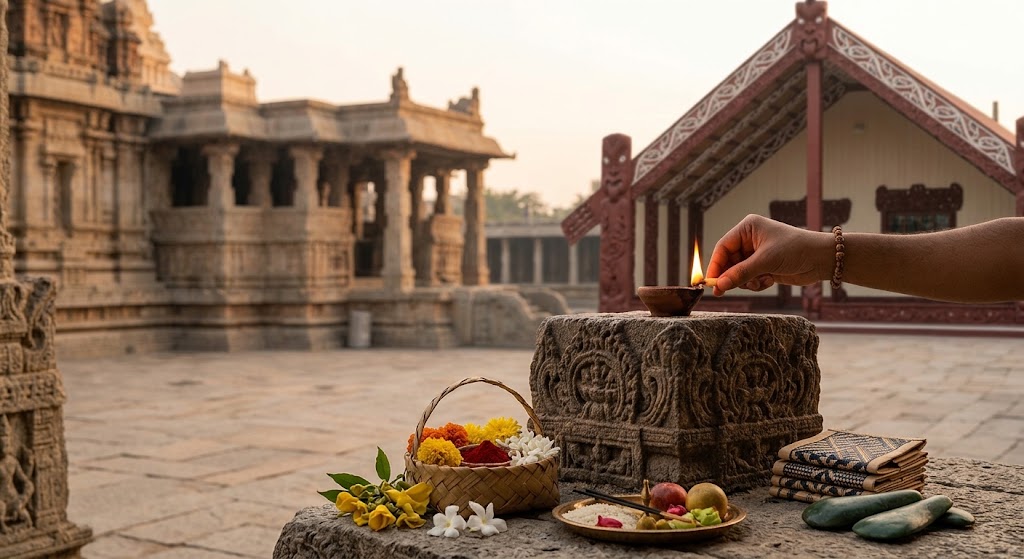
When viewed through a conventional, regional lens, the ancient traditions of Bharatvarsha (the Indian subcontinent) and the Indigenous Te Ao Māori (the Māori worldview) of Aotearoa New Zealand might appear worlds apart. Yet, when we move past superficial geographical boundaries, a profound philosophical and metaphysical resonance emerges. Neither tradition operates on rigid dogmatic theology or structured commandments. Instead, both are inherently organic, holistic ways of life rooted in cosmic order, ancestor reverence, and an intricate spiritual connection to the natural environment.
1. Rta and Tikanga: Cosmic Order and Righteous Living
At the foundation of Sanatana Dharma lies the concept of Rta—the fundamental cosmic law that governs the rhythm of the universe, ensuring that seasons turn, celestial bodies move, and nature functions in harmony. Dharma is the human responsibility to uphold and live in alignment with this cosmic order.
In Te Ao Māori, a closely aligned concept exists in Tikanga. Rooted in the word tika (meaning 'correct' or 'right'), Tikanga represents the customary system of values and practices that maintains social balance and harmony with the environment. Like Dharma, Tikanga is not a set of static legalistic rules, but an evolving, ethical framework designed to ensure that human actions remain aligned with natural and spiritual principles.
2. Prakriti and Papatūānuku: Earth as the Divine Mother
A cornerstone of both Hindu and Māori cultures is the deep, spiritual reverence for the Earth as a living, sacred entity rather than mere material real estate.
- In the Hindu tradition, the Earth is revered as Bhoomi Devi or Prakriti—the primal cosmic energy and universal mother who sustains all life. Rivers like the Ganga, Yamuna, and Saraswati are not merely bodies of water; they are venerated as living Devis (divine manifestations) possessing spiritual purity and consciousness.
- In Te Ao Māori, the Earth is Papatūānuku (Earth Mother), who, along with Ranginui (Sky Father), acts as the progenitor of all living things. Natural elements—forests, mountains, and rivers—are personified as Atua (guardians or departmental deities). A prime example of this shared reverence is the Whanganui River, which was granted legal personhood in New Zealand law—a recognition deeply resonant with the Indian Supreme Court's decisions regarding the legal personhood of the Ganga and Yamuna rivers.
3. Whakapapa and Gotra: Interconnectedness and Lineage
Both traditions place immense value on ancestral roots and the genealogical continuity that connects the individual to the cosmos.
- Māori Whakapapa:Whakapapa (genealogy) forms the fundamental structure of Māori identity. It maps an individual's lineage back through generations of ancestors, extending all the way to the Atua and the creation of the universe itself. It posits that humans do not stand above nature, but are genealogical kin to trees, birds, and waters.
- Hindu Gotra and Vamsha: Similarly, the Hindu framework relies on Gotra (lineage traced back to ancient seers or Rishis) and Vamsha to trace ancestry. Furthermore, Hindu philosophy posits that human existence is part of an unbroken web of creation where every soul (Atman) is interconnected with all living beings (Vasudhaiva Kutumbakam—the world is one family).
4. Tapu and Pavitrata: Sacredness and Spiritual Protocols
The management of spiritual energy forms a practical part of daily life in both cultures.
- Māori Tapu and Noa:Tapu denotes that which is sacred, restricted, or set apart, carrying spiritual protection from the Atua. Noa, on the other hand, refers to that which is ordinary, safe, or free from restriction. The balance between Tapu and Noa governs social interactions, food preparation, and sacred spaces.
- Hindu Pavitrata and Ashoucha: In Hindu practice, spiritual purity (Pavitrata or Shuddhi) is maintained through specific rituals, hygiene practices, and dietary considerations. Sacred spaces (like the Garbhagriha or sanctum sanctorum of a temple) are held in a state equivalent to Tapu, requiring specific cleansing rituals (Snana, Mantra) before entry.
5. Mauri and Prana: The Universal Life Force
The understanding of vital energy is remarkably similar across both indigenous frameworks:
- Māori Mauri:Mauri is the essential life spark or force that resides in all things—both animate and inanimate. A person, a forest, a river, or even a carved wooden building possesses Mauri. When Mauri is strong, vitality flourishes; if it is diminished, decline sets in.
- Hindu Prana:Prana is the universal life-breath that permeates every atom of the universe. In Yogic philosophy, the cultivation and harmonization of Prana through Pranayama (breath control) and conscious living is essential for maintaining physical health, mental clarity, and spiritual elevation.
6. Ancestral Homage: Tangi and Shraddha
Reverence for those who have passed beyond the physical realm is treated with the utmost solemnity in both traditions.
During a Māori Tangi (funeral gathering), the community comes together over several days to mourn, honor, and bid farewell to the departed soul, speaking directly to the spirit as it begins its journey to Hawaiki (the ancestral spiritual realm).
In the Hindu tradition, the transition of the soul (Atman) is observed through rites (Antyesti) followed by annual ancestral homage known as Shraddha or Pitru Paksha. Offerings (Pinda) and prayers are made to nourish the ancestors (Pitrus), acknowledging an eternal debt of gratitude (Pitru Rina) that transcends physical death.
Summary: A Shared Paradigm of Wholeness
While historical and geographical contexts differ, the underlying spiritual orientation of Hindu and Māori traditions shares an unmistakable essence. Both cultures reject the anthropocentric view that humanity holds dominion over the natural world. Instead, they offer a profound, eco-spiritual model for existence: one that sees the individual not as an isolated actor, but as a thread woven into a vast, sacred fabric of ancestors, natural elements, and cosmic order.